Replacing or installing a driveway in Kansas City means choosing between two proven materials. Concrete and asphalt both hold up under regular use, but they perform differently in this climate, cost differently upfront, and require different levels of attention over time. Here is what you need to know before making the call.
What Each Material Costs to Install
Asphalt is cheaper to install. In the Kansas City market, asphalt typically runs $3 to $7 per square foot installed, while concrete runs $4 to $8 per square foot for a standard finish. On a two-car driveway, that gap can translate to $400 to $2,400 in upfront savings with asphalt. Decorative concrete finishes like stamped or stained patterns push costs higher, up to $18 per square foot.
That cost difference is real, but it does not tell the whole story. Asphalt requires resealing every three to five years to maintain its integrity. Each sealing job adds to the long-term cost. Concrete needs far less ongoing maintenance, which closes the gap considerably over the life of the driveway.
If upfront budget is a concern, we offer flexible project financing that can make a concrete driveway viable without stretching your cash flow.
How Kansas City’s Climate Affects Both Materials
Kansas City’s climate is genuinely split, and that matters for this decision. Winters bring freeze-thaw cycles that stress rigid surfaces. Summers push heat indexes well above 100 degrees. No driveway material handles both extremes perfectly.
Asphalt is more flexible than concrete, which gives it an advantage during freeze-thaw cycles. That flexibility lets it shift slightly without cracking when the ground beneath it moves. The downside is summer heat. Asphalt softens in sustained high temperatures, which can lead to surface rutting and edge crumbling over time. It also absorbs heat, making it significantly hotter to walk on in summer.
Concrete handles heat better and holds its shape through hot Kansas City summers. The tradeoff is that concrete is more rigid. Freeze-thaw cycles and de-icing salts can cause surface scaling and cracking, particularly if drainage and expansion joints were not installed correctly. A properly installed concrete driveway with the right joint placement manages this risk effectively.
Lifespan and Long-Term Value
This is where concrete pulls ahead. A well-installed concrete driveway in Kansas City can last 30 to 50 years with proper maintenance. Asphalt typically lasts 15 to 30 years, with real-world Kansas City conditions pushing most installations toward the lower end of that range.
The practical implication is straightforward. Install asphalt today and you are likely looking at a full replacement in 15 to 20 years at whatever prices have inflated to by then. Concrete installed at the same time could outlast your plans for the property entirely.
When you factor in replacement cost, maintenance, and lifespan, concrete delivers better long-term value for most homeowners. The higher upfront cost is an investment in not doing this again.
Maintenance Requirements
Asphalt demands more consistent attention. A new asphalt driveway should be sealed within the first year after installation, then resealed every three to five years after that. Skipping sealcoating accelerates surface degradation and shortens the driveway’s lifespan. Repairs to asphalt cost $250 to $800 and are relatively straightforward, but they come up more frequently.
Concrete is largely low maintenance. Occasional cleaning, prompt crack repair, and avoiding heavy de-icing salt use in winter will keep a concrete driveway performing well for decades. When damage does occur, concrete repairs cost $300 to $3,000 depending on the extent, but the incidents are far less frequent.
Appearance and Customization
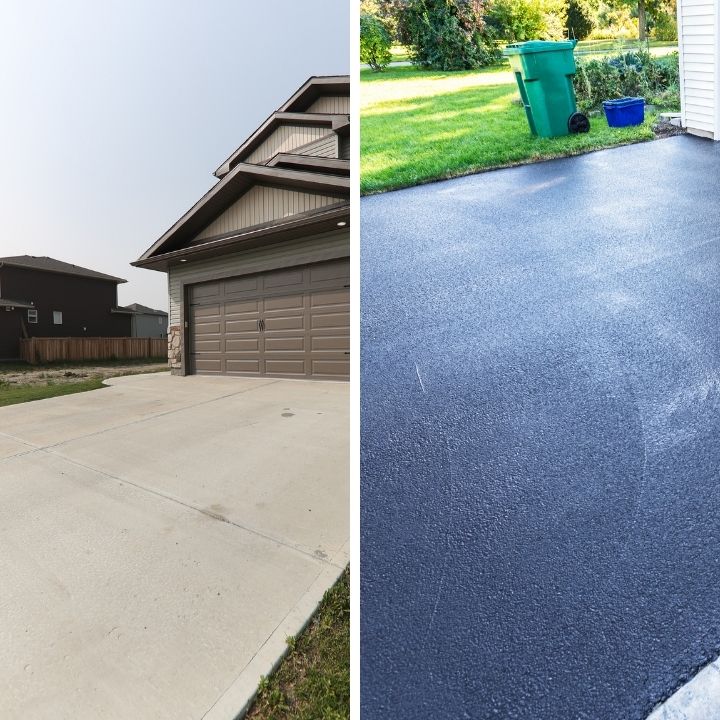
Concrete gives you more options. It can be finished in brushed, stamped, exposed aggregate, or colored patterns that complement the home’s exterior. Asphalt has one look, and it fades from deep black to grey as the surface ages regardless of maintenance.
For homeowners where curb appeal is part of the equation, concrete has a clear advantage. For a straightforward functional driveway with no aesthetic priority, asphalt gets the job done at a lower entry cost.
Which One Is Right for You
Asphalt makes sense if your upfront budget is tight, you are comfortable with regular maintenance, and you are not planning to stay in the home for more than 15 years.
Concrete makes sense if you want a surface that lasts, requires minimal upkeep, and adds long-term value to the property. For most Kansas City homeowners planning to stay in their home for the long haul, concrete is the stronger investment.
A.I. Building Solutions installs both concrete and asphalt driveways across Jackson, Cass, and Johnson counties. We also handle premium home renovations that can be planned alongside your driveway project. Contact us to get a free estimate and talk through which option fits your property and your budget.