
The clearest signs of roof damage in the attic show up months before a stain reaches a ceiling below. Sheathing, rafters, nail tips, and insulation all record what has been happening above them, and the pattern separates an active leak from a ventilation problem that only looks like one. What follows is what to look for on a Kansas City attic inspection, what each finding traces back to, and where the attic stops being able to tell you anything.
Why the Attic Shows Damage Before the Ceiling Does
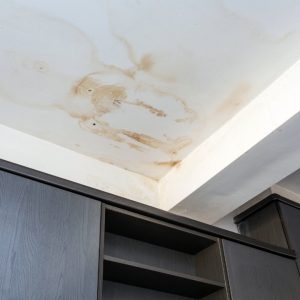
Water entering a roof assembly has to saturate sheathing, run down framing, and soak through insulation before drywall stains. That sequence takes time, and by the time a ceiling shows a ring, the decking above it has usually been wet through multiple cycles.
Ventilation problems follow a different path entirely. Warm humid air from the living space rises into the attic, meets a cold roof deck in January, and condenses on the underside of the sheathing. The result looks like a leak, drips like a leak, and produces the same staining, but no water ever came through the roof. Telling those two apart from inside determines whether the next call is about a repair, a claim, or a ventilation correction that has nothing to do with shingles.
Daylight Through the Roof Deck
Pinpoints of daylight through the sheathing mean the deck has openings. On an older roof, that often traces to nail holes from previous layers, a split in the decking, or gaps that opened as boards dried and shrank. Around a penetration, daylight means flashing has separated.
Daylight alone does not prove an active leak. Water follows a slope and needs a path, so a hole on a well drained plane may never wet anything. What daylight does prove is that the deck is no longer continuous, and that matters most at valleys, around chimneys, at plumbing vent penetrations, and along eaves where wind driven rain gets pushed uphill. Mark every point of light with tape and check those exact locations after the next heavy rain.
Staining on the Sheathing Versus Staining on the Rafters
Location narrows the cause faster than anything else in an attic.
Staining concentrated on the underside of the sheathing, spread evenly across a broad area, usually points to condensation. Moisture forms across the whole cold surface rather than at one entry point, so the pattern is diffuse and often worse on the north facing plane.
Staining that runs down a rafter or a truss chord in a defined streak points to water entering at a specific place above and traveling along framing. Follow the streak uphill. The entry point is at or above the highest stain, though not always directly above, since water can travel a considerable distance along a rafter before dropping.
Dark rings with defined edges are old and dry. Damp, soft, or delaminating sheathing is active. Pressing a screwdriver tip into stained decking tells you which one you have, and decking that gives under light pressure has lost structural value and will need replacement at the next tear off.
Rusted Nail Tips and What They Rule Out
Shingle nails penetrating the deck are visible from below as rows of points. Rust on those tips is one of the most reliable condensation indicators available to a homeowner. Metal is the coldest surface in the assembly, so moisture condenses there first, and repeated wetting corrodes the exposed steel.
Widespread rusted nail tips across an entire plane are a ventilation and air sealing problem, not a roofing problem. Replacing shingles will not stop it. Rust confined to a small cluster near a bathroom or kitchen usually means humid air is entering the attic at one location, often an unsealed can light, a plumbing chase, or an exhaust duct that terminates in the attic instead of through the roof or wall.
Ventilation Failures That Get Mistaken for Leaks
The code baseline in IRC Section R806 is one square foot of net free ventilating area for every 150 square feet of attic floor area. That drops to one in 300 only when 40 to 50 percent of the required area sits in the upper portion of the attic, within three feet of the ridge, with the balance at the eaves. Balance is the requirement people skip. Exhaust without intake pulls conditioned air up out of the house instead of drawing outside air through the attic.
Kansas City sits in climate zone 4A, which means humid summers and a real winter, and attics here get worked from both directions. Common failures visible from inside include:
- Soffit vents buried under blown insulation that drifted or was installed over the eave
- Missing baffles at the eaves, which lets insulation block the intake path permanently
- A bathroom or dryer exhaust duct discharging directly into the attic
- Gable vents and ridge vents operating together, which short circuits airflow so the ridge pulls from the gable instead of the eaves
- Insulation pulled away or matted in a specific area, which marks where air is moving through
Frost on the underside of the sheathing during a cold snap is the unambiguous version of this. It melts when temperatures rise and drips onto insulation and ceilings, and homeowners reasonably report it as a roof leak. The roof is intact. The air sealing and ventilation are not.
Signs of Roof Damage in the Attic After a Storm
Wind and hail leave different evidence, and the attic is better at recording one than the other.
Wind damage often shows as new daylight where shingles lifted and nails backed out, or as fresh water tracks at a location that was dry before. Decking that moves underfoot or shows shiny nail shanks pulled partway through indicates uplift. Water entry at valleys and around penetrations after a storm points to flashing that shifted.
Hail is harder to confirm from below. Impact bruises the shingle mat and dislodges granules without necessarily breaching the deck, which means severe hail damage can be present with a completely dry attic. Splits in the decking or fresh light at fastener locations after a hail event indicate that impact reached the substrate, but the absence of attic evidence proves nothing about the shingle surface. Storm damage roof repairs still start with a roof level inspection and documentation before an adjuster is involved.
Inspecting an Attic Without Making It Worse
Step only on framing members and never on drywall between them. Bring a bright flashlight and shine it across surfaces at a low angle rather than straight on, since raking light reveals staining and texture that direct light washes out. A moisture meter is useful but a screwdriver and hand pressure will identify soft decking.
The best time to look is during or immediately after a sustained rain, when active leaks are visible as wet surfaces rather than as historical stains. The second best time is during a hard freeze, when condensation and frost problems are at their most obvious. An attic inspected on a dry day in October will hide both.
Wear a respirator if insulation is disturbed and stop entirely if visible mold growth is widespread, since disturbing it puts spores into the air handling system. Extensive moisture damage in an attic is a remediation project with its own standards, not a cleanup task.
What the Attic Cannot Tell You
An attic inspection has real limits, and treating it as a complete assessment is how homeowners talk themselves out of a roof that needs replacing.
Granule loss, shingle bruising, sealant failure at flashing, cracked pipe boots, and aging on the exposed surface are all invisible from below. Roofs with a second layer of shingles over the original hide even more. A structure with spray foam applied to the roof deck or a finished cathedral ceiling has no accessible attic at all, and moisture problems in those assemblies stay concealed until they are severe.
The attic tells you whether water is getting in and where it is traveling. It does not tell you how much life the covering has left. Both questions need answering before deciding between residential roofing replacement and another season of repairs.
Reading the Evidence Before Calling
Diffuse staining across the sheathing with rusted nail tips is a ventilation and air sealing issue, and a new roof will not fix it. A defined streak down a rafter is an active leak with a findable entry point above it. Daylight through the deck means the substrate is compromised even when nothing is currently wet. Frost in winter is condensation, not a roof failure. Soft decking that yields under a screwdriver is already past repair.
Knowing which of those you have before making a call changes the conversation from a general complaint into a specific problem, and it makes it much harder to be sold work that does not address the actual cause. When the evidence does point to replacement, financing options for home projects keep the decision about the right scope rather than the cheapest patch.
Found Something in Your Attic A.I. Building Solutions inspects the roof and the attic together, so a ventilation problem does not get treated as a leak and a leak does not get sealed over. We are a veteran owned general contractor serving Jackson, Cass and Johnson counties, GAF Commercial, GACO and IICRC certified. Call (816) 835-2094 for a free assessment. |