Cracks in a slab range from harmless to expensive, and the types of concrete cracks on the surface tell you which one you are looking at. Width, timing, location, and whether the two sides still sit level all point toward a specific cause. What follows breaks down the patterns that show up on driveways, patios, and garage floors in Kansas City, what each one traces back to, and which ones justify a call.
Why Every Concrete Slab Cracks
Concrete is strong in compression and weak in tension. It shrinks as it cures and it keeps moving with temperature and moisture for the rest of its service life. When something restrains that movement, tensile stress builds until it exceeds what the concrete can hold, and a crack relieves it. Crack free concrete does not exist, and a contractor who promises it is describing something that has never been poured.
Industry guidance from NRMCA attributes the majority of cracking to design and construction decisions rather than to the material itself. Missing or badly placed joints, poor subgrade preparation, excess water added on the job, improper finishing, rapid moisture loss during placement, and inadequate curing account for most of what homeowners end up looking at. Weather is the trigger. The decisions made on pour day determine how much damage the trigger does.
Crazing, the Shallow Web That Looks Worse Than It Is
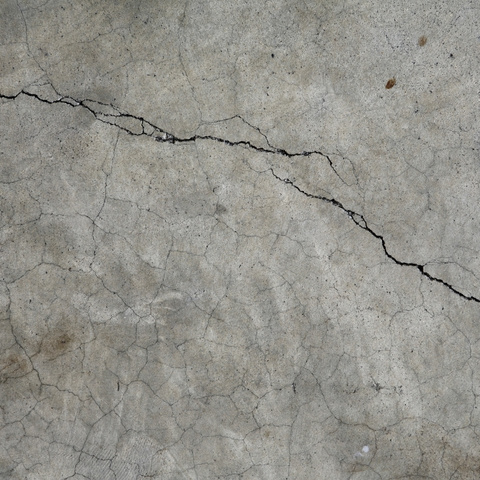
A dense network of fine lines across the surface, visible the day after placement or by the end of the first week, is crazing. The cracks are rarely deeper than an eighth of an inch, and the irregular shapes between them are typically no more than an inch and a half across. Crazing shows up most clearly when a wet surface starts to dry, which is why it often gets noticed for the first time after a rain.
It is cosmetic. Crazing does not affect structural integrity and it is not a precursor to future deterioration. What it does reveal is finishing practice. Water sprinkled on the surface to make troweling easier, dry cement broadcast to soak up bleed water, finishing that started before the slab finished bleeding, or curing that never happened will all produce it. Sealing improves the appearance, since dirt working into the lines is what makes crazing more obvious over time.
Plastic Shrinkage Cracks From a Hot Kansas City Pour
Short, roughly parallel cracks that appeared within hours of the pour, before anyone walked on the slab, are plastic shrinkage cracks. They form while the concrete is still plastic, when water evaporates from the surface faster than bleed water can rise to replace it. The surface shrinks against a body of concrete that has not moved yet, and it tears.
July and August pours are the risk window here. High air temperature, low humidity, direct sun, and wind all drive the evaporation rate up, and wind does more damage than most people expect. Windbreaks, fog spraying, evaporation retarders, and covering the slab between finishing operations are the standard protections. These cracks are usually shallow and rarely structural, but they are an honest record of whether the crew protected the pour.
Random Cracks That Ignore the Control Joints
A crack running diagonally across the middle of a panel, or straight from one edge to the other with both sides still level, is drying shrinkage finding its own path. Control joints exist to give that shrinkage a designated place to land. Space the joints too far apart, cut them too shallow, or cut them too late, and the slab cracks where it wants to instead.
The specifications are not vague. Contraction joints belong at 24 to 36 times the slab thickness, with fifteen feet often treated as a practical maximum, and the cut needs to reach a quarter to a third of the slab depth. Panels should be square or close to it, with length no more than about one and a half times the width. A four inch slab with joints at eighteen feet was going to crack from the day it was finished, which is why slab thickness and joint layout have to be specified together.
Reinforcement does not change this. Wire mesh and rebar cannot prevent cracking. Positioned correctly, they hold the crack tight so the two sides stay level and the opening stays narrow, which is the difference between a line you seal once and a joint that keeps deteriorating.
Corner Cracks Where the Slab Meets Something Solid
A crack running at an angle off an inside corner, or a line where the driveway meets the garage slab, points to a missing isolation joint. Anywhere the slab is prevented from moving independently becomes a stress concentration point. A foundation wall, a garage floor, a stoop, a light post footing, and a curb all qualify. Isolation joints run the full thickness of the slab and let each element move on its own schedule.
Reentrant corners are the classic version of this failure. Where a driveway wraps around a garage projection or a patio notches around a bump out, the inside corner concentrates stress and it will crack unless a joint is placed to intercept it. That crack is predictable enough that its presence says the joint plan was never drawn.
Settlement Cracks and Kansas City Clay
A crack with one side sitting visibly lower than the other is a support problem, not a concrete problem. The slab did not fail on its own. Something underneath it moved or washed out, and the concrete broke while bridging the gap.
Expansive clay is common across Jackson, Cass, and Johnson counties, and it changes volume with moisture. It swells through a wet spring and shrinks through a dry August, and a slab resting on it rides that movement every year. Poor drainage intensifies the cycle. Grade should carry water away from structures at roughly six inches of fall within the first ten feet, and a downspout discharging next to a slab edge will undermine it faster than weather ever will.
Frost adds a second mechanism. Frost depth in Kansas City runs 36 inches, and flatwork sits nowhere near that deep, so the subgrade beneath a slab freezes and lifts every winter. Well drained granular fill absorbs that movement. Saturated clay transmits it straight into the concrete, which is the same soil behavior that governs how deep footings have to be placed. Displacement cracks that grow season over season are the ones that end in replacement rather than repair.
D-Cracking, the Pattern That Signals Real Deterioration
Fine cracks running parallel to joints and slab edges, curving around corners, often with dark staining along the lines, are D-cracks. They come from freeze and thaw damage inside porous aggregate rather than at the surface. Water collects at the bottom of the slab near joints, saturates the aggregate, and freezing breaks it apart from the inside. The deterioration starts at the bottom and works upward, which is why D-cracking shows up years into service instead of in the first season.
This is one of only two crack patterns that indicate genuine deterioration rather than cosmetic or one time damage. The other is alkali aggregate reaction, which produces a map-like pattern that resembles crazing at a glance but keeps widening and eventually causes structural damage. Both trace back to the aggregate in the mix, which makes them a specification and supplier issue that surface repair does not address. A slab with progressing D-cracking is on a replacement timeline, not a maintenance one.
Types of Concrete Cracks That Need Attention Now
Most early cracking is permanent, harmless, and not worth acting on. These are the conditions that change that:
- Vertical displacement, where one side of the crack sits lower than the other
- A crack that has measurably widened across one or two seasons
- Cracks parallel to joints and edges with staining, the D-cracking signature
- Any crack open enough to take water, in a climate that will freeze it
- Multiple cracks radiating from one point, which usually means a void underneath
- Spalling or flaking along the crack edges, meaning the opening is now taking damage of its own
Sealing a crack that has stopped moving is worthwhile maintenance and best done before winter, since water entering a crack and freezing widens it a little more every cycle. Sealing a crack that is still moving accomplishes nothing. Telling the two apart takes measuring and a season of patience, or an assessment of the support conditions underneath by a concrete contractor who will look at drainage and subgrade rather than just the surface.
What the Pattern Tells You Before You Call
Timing narrows the cause faster than anything else. Cracks visible within hours point to evaporation during placement. Cracks in the first week point to finishing and curing. Cracks in the first year point to joint layout and spacing. Cracks that appear years later and follow the joints point to the aggregate. Cracks with displacement point to the ground.
Width and level tell you the urgency. Tight and even is a maintenance item. Wide and offset is a support investigation. Everything else falls in between, and how long a concrete driveway lasts in Kansas City depends far more on which category the cracking falls into than on how many cracks there are.
Not Sure What Your Cracks Are Telling You A.I. Building Solutions evaluates cracked flatwork by looking at drainage, subgrade and joint layout, not just the surface, so you know whether you are sealing a crack or planning a replacement. We are a veteran owned general contractor serving Jackson, Cass and Johnson counties. Call (816) 835-2094 for a free on site assessment. |