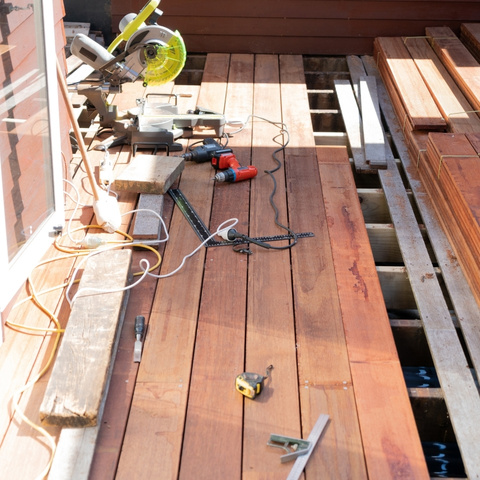
Signs your deck needs replacing rarely show up on the walking surface, which is the reason so many Kansas City homeowners spend two seasons replacing boards on a structure that was already finished. Surface problems are repairable. Structural problems are not, and the difference comes down to what is happening at the ledger, the posts, and the connections nobody looks at. Most custom deck builds in Kansas City that get torn out were repaired at least once before somebody checked the framing.
Ledger Board Failure Ends the Repair Conversation
The ledger board is the piece that fastens the deck to the house, and it carries roughly half the total load of the structure. Ledger failure is the leading cause of catastrophic deck collapse, and it fails without warning because the damage happens behind the board where nothing is visible.
Water gets behind an unflashed or poorly flashed ledger and stays there. The rim joist of the house rots from the outside in, which means the deck can be sound while the surface it hangs from is not. Probing the band joist from inside the basement or crawlspace tells the story faster than anything visible from the yard.
Attachment method matters just as much. Decks fastened with nails, or with lag screws at the wrong spacing, do not meet current standards and cannot be brought into compliance by adding hardware to compromised wood. Once the rim joist is soft, the deck comes off and the framing gets repaired before anything new goes back on.
A replacement at this stage triggers a permit and inspection in most jurisdictions, since reattachment is structural work. Review deck permit requirements in Kansas City before scheduling, because the ledger connection is one of the items an inspector will want to see before it gets covered.
Posts and Footings That Have Moved
Footings decide whether everything above them stays level. Kansas City requires footings below a 36-inch frost depth, and a large number of older decks were built on shallow piers, precast blocks, or posts set directly into soil. Those decks move every winter.
Signs of footing movement show up as a deck that slopes away from level in one corner, gaps opening between the decking and the house, doors on the deck side that stick seasonally, and posts that no longer sit plumb. Shimming a beam corrects the symptom for a season and does nothing about the pier still sitting above the frost line.
Post bases are the other failure point. Posts in direct ground contact wick moisture upward and rot at the worst possible location, right where the load transfers. A post that sounds hollow when struck or accepts a screwdriver tip more than a quarter inch is carrying load it can no longer be trusted with.
Correcting footings under an existing deck means lifting and supporting the entire structure while new piers get poured, which frequently costs more than tearing out and rebuilding. Confirm the footing depth requirements in Kansas City that apply to your lot, and plan on new concrete footings and flatwork being part of the scope if the original piers never reached depth.
Fastener Corrosion in Decks Built in the Mid-2000s
Decks built between roughly 2004 and 2010 sit in a specific window worth checking. Residential CCA treated lumber was phased out in favor of ACQ and copper azole formulations, which are significantly more corrosive to steel. Standard galvanized fasteners and joist hangers installed during that transition were never rated for the new chemistry.
The result is corrosion at every connection point, hidden inside hangers and behind boards. Rust staining that bleeds down from a joist hanger, hangers that have lost their coating, and lag bolts with visible section loss all point to the same problem, and it is present across the entire structure rather than in one spot.
Replacing individual hangers on a deck with system-wide fastener corrosion treats one connection while the rest keep deteriorating. When the fasteners were wrong from the start, the structure has a service life that ends regardless of how sound the lumber looks.
Rot That Runs Past the Surface Boards
Surface board replacement is legitimate repair work. A handful of cupped, cracked, or splintered deck boards on otherwise sound framing is a maintenance item and nothing more.
Rot in the framing is a different finding. Probe the joists at the ledger end, the beam where it sits on posts, and the cut ends of any lumber that was field-trimmed and never sealed. Wood that gives under a screwdriver, feels spongy, or shows dark staining along the grain has lost structural capacity that no surface treatment restores.
The scope test is simple. Rot confined to one or two joists is a repair. Rot appearing at multiple locations across different framing members means moisture has been present system-wide for years, and the sound sections are on the same timeline as the failed ones.
Railings and Stairs That No Longer Meet Code
Older decks routinely fall short of current requirements. Guards are mandatory when the walking surface sits more than 30 inches above grade, residential guard height runs a 36-inch minimum, openings cannot pass a 4-inch sphere, and guards have to resist a 200-pound concentrated load applied in any direction at the top.
A railing that flexes under hand pressure fails that load requirement. So does a guard bolted to a rim joist with no blocking behind it, which is the most common condition on decks built before the connection details were enforced.
Stairs add their own set of problems. Riser height variation, tread depth below minimum, missing graspable handrails, and no landing at the bottom are all correctable in isolation. When they appear alongside framing issues, the stair rebuild folds into the larger project. Upgrading deck railing systems on a deck scheduled for replacement wastes the work, so the railing decision belongs after the structural call, not before it. Homeowners weighing options usually start by looking at how cable railing and wood railing compare on framing demands and long-term upkeep.
When the Repair Math Stops Working
A practical threshold applies. When the repair scope approaches half the cost of a new deck, replacement is the better position, because repair work buys remaining years on a structure that is already partway through its service life while replacement resets the clock entirely.
Pressure treated framing maintained well runs a couple of decades in this climate. Framing that has been through repeated freeze-thaw cycling in Climate Zone 4A with deferred maintenance runs considerably less. A deck approaching that range with two or more of the conditions above is not a repair candidate.
Sequencing matters too. Money spent on new decking over compromised framing is spent twice, since the boards come off again when the structure gets addressed.
Scope often expands once the framing is exposed and the actual condition is visible, which is why flexible project financing matters on this kind of project. Building it correctly the first time costs less than a staged repair sequence spread across several seasons.
What Replacement Actually Gets You
A new deck built to current code brings the ledger connection, footing depth, fastener specification, and guard loading up to standard at the same time. Those four items are where nearly every failure originates, and they get resolved together rather than one at a time.
Replacement also opens the material decision that a repair never allows. Framing, decking, and railing get specified as one system, which affects joist spacing, fastener type, and long-term maintenance. Start with choosing decking material before the layout gets finalized, since the surface material changes what the framing below it has to do.
Layout is worth revisiting as well. Deck footprints from twenty years ago were sized around different uses, and a replacement is the point where traffic flow, stair placement, and connection to the house get reconsidered. On premium home renovation projects, the deck usually gets designed alongside the rest of the exterior scope rather than in isolation.
Making the Call
Check four things before deciding. Probe the rim joist behind the ledger. Confirm whether the footings reach past 36 inches. Look inside the joist hangers for corrosion. Push hard on the railing and see what moves.
One finding among those is usually a repair. Two or more means the structure has systemic problems, and every dollar spent on repair is buying time on a deck that comes out anyway.
A deck that looks tired is a maintenance question. A deck with compromised connections is a safety question, and those get answered differently.
Not sure if your deck needs repair or replacement?
We inspect the framing, footings, and connections before recommending scope. Call (816) 835-2094 for a free quote.